Saturday, September 27, 2008

I'm never leaving Tucson.

On this fine weekend for a road trip, we here at It’s A Fine Day For A Beer are soaking in the suds and baking in the desert sun at the Great Tucson Beer Festival. 


We could send a postcard, sure – but why do that when we’ve got something better?


First, for your listening pleasure, an ode of sorts to this desert locale by the underappreciated and long since dissolved Trona (not to be confused with either of the lesser Tronae parading around on MySpace).


And now – can we get a drum roll? – for your permanent collection, a brand new track from a band that originated right here in Tucson. If you’ve seen them, you already know them as The Greatest Rock ‘n Roll Band in the World. If not, you only know them as The Supersuckers.


Their new album Get It Together – “far and away the most awesome thing we've ever recorded," in the ever-humble opinion of singer/bassist Eddie Spaghetti – isn’t out until November 25. But here in the land of beer, we have the lead track from that album, titled “What It Takes.” All it takes for you to check it out is a mouse click. All it takes for you download it is a mouse click. Grab yourself a 12 oz. treat from the fridge and start clicking.


Thursday, September 25, 2008

The Cathedral and the Bandbox


Earlier this week, baseball said goodbye to one of its most revered – and certainly its most reviled – ballparks, New York’s Yankee Stadium.


In the interest of full disclosure, it should be noted that here at Fine Day Industries, there as an institutional bias against the New York Yankees. A strong institutional bias. In fact, one might safely call it a hatred. Just the same, it is impossible not to respect the history that has unfolded in that ballpark (the date October 20, 2004 comes to mind). It is impossible not to be in awe of the legends of the game – many of whom are legends even among legends – who have called Yankee Stadium home in the years since it opened in 1923. 


Loath though we are to admit it, there is even a perverse pleasure in the fact that the Yankees were able to bid The Stadium farewell in victory. In the interest of stating what is by now the obvious, it should be noted that the notion of “pleasure” here owes a great debt to the fact that the mighty Yankees have fallen, missing baseball’s postseason for the first time since...well, ever in the careers of Mariano Rivera, Derek Jeter, and Jorge Posada. That is a glorious thing, worthy of a beer in itself – whether to revel in their fall, or to applaud their run of greatness. With the Yankees but a footnote to the 2008 season, though, it's a painless concession to accept that Yankee Stadium receive a sendoff – for one day, anyway – befitting its illustrious past.


That past began on April 18, 1923 – against the Boston Red Sox no less – when Babe Ruth “smash[ed] a savage home run,” as the New York Times put it, in the ballpark’s inaugural game. “And that was the real baptism of Yankee Stadium.” World Series titles followed. Lots of them. Just ask any Yankees fan. They’ll tell you how many. Some even like to imply that they played some part in all that success. They are, one hopes, a boisterous minority.


Yankee Stadium ceased to be The House That Ruth Built, in any aesthetic sense, after a major renovation that bumped the Yankees to Shea Stadium for the 1974 and 1975 seasons. Even in its subsequent altered state, though, Yankee Stadium continued to be home to baseball history. It will be missed. Not by anyone currently in the employ of It’s A Fine Day For A Beer, mind you. But it will certainly be missed – so we honor its 85 years of baseball.


As one of baseball’s grand old parks recedes into history, though, we celebrate the breaking of ground on this day in 1911 on the site that would become Fenway Park.  Most famously described by John Updike (in The New Yorker, naturally) as “a lyric little bandbox of a ballpark,” Fenway is baseball’s oldest living ballpark and surely its quirkiest. Updike’s 1960 essay “Hub Fans Bid Kid Adieu” continues:


Everything is painted green and seems in curiously sharp focus, like the inside of an old-fashioned peeping-type Easter egg. It was built in 1912 and rebuilt in 1934, and offers, as do most Boston artifacts, a compromise between Man’s Euclidean determinations and Nature’s beguiling irregularities.


As Updike captures the rugged poetry of the park, Boston’s most beloved (or perhaps not) baseball scribe, Dan Shaughnessy, expresses the simple wonder of losing one’s Fenway virginity in his 1996 book At Fenway:


The best entrance to the open-air Fenway yard is the portal just to the right of home plate. This is an absolute. We can debate the best place to watch the sunrise on Cape Cod or the best place to see New England’s leaves turn in October, but there’s no room for argument when it comes to your first sight of Fenway…


…We went up that ramp, and the majesty of Fenway’s green unfolded before my eyes. Children today probably wouldn’t have the same reaction, but after years of seeing everything in black and white on our twenty-four-inch Zenith, it was the color of green that got my attention. Think of The Wizard of Oz when a young Judy Garland wanders out of her storm-shattered house and into the lush land of Oz. It’s the first splash of color in the classic film, and this scene often comes to mind when baby boomer Bostonians speak of their first glimpse of the venerable Boston ballyard.


It’s a near-perfect analysis, save for the faulty assumption that children in the color TV era would be underwhelmed. The green of Fenway is stunning, no matter how many times you’ve seen it – particularly at night, under sable sky with the Prudential tower marking the Boston skyline beyond right field, the Citgo sign in Kenmore Square illuminating the horizon past the left field wall, and the diamond below sparkling beneath endless banks of lights.


Echoing Updike, Shaughnessy says, “The green gets your attention. It makes the Red Sox tuxedo-white uniforms stand out. It is the backdrop that put[s] everything into focus.” Indeed, that is Fenway. Undoubtedly it is not alone among ballparks in eliciting such awe. But it is, for sure, a magical place.


To two vestiges of baseball’s bygone days, a non-partisan toast on an autumn day – a fine autumn day for a beer.


To be continued...

Wednesday, September 24, 2008

An un-birthday celebration


If there were a world record for least time spent trying to decide precisely why today is a fine day for a beer, this could have been it.


On this day in 1725, the true patron saint of Ireland, the man whose legacy is our nourishment on St. Patrick’s Day (and so many other days), Sir Arthur Guinness was born in Dublin. Or, so says that great purveyor of fact and myth, Wikipedia. This was to be the fine day that wrote itself. No other beer is so pervasive as a cultural symbol. And besides, Guinness is good for you.


Ah, but there’s a catch. The Peerage puts his birth date at March 12, 1725. Of course, there’s something fishy there, too: if they are to be trusted, then his son Arthur Guinness was also born on March 12 (1768). It’s not an impossible coincidence. The man had 10 children (with more than a little help from his wife, it should be noted). There are 365 days in a year. Arthur Guinness was apparently born on two of them. If the odds aren’t his favor, it’s not exactly a Nader-for-President (he’s running again, you know) level longshot that Guinness would share a birthday with one of his progeny.


Meanwhile, this Wikipedian notion that Arthur Guinness was born in Dublin is surely a fallacy. The official version of the story is that Guinness was born near Celbridge, in County Kildare – a short but significant 20 kilometers west of Dublin. There is ample corroboration of this (none of it reliable, mind you) from multiple sources on the World Wide Web of Truth.


What do we really know, then? We know that Arthur’s Round has been moved to the top of the Christmas list.


We know that Arthur Guinness was no Josef Bierbitzch, that’s for sure. He was, in fact, a real person. He did create a wonderful brew, a drink that is an emblem of Irish pride and national identity. Is today his birthday? Yes. No. Maybe. Oh well, whatever. Nevermind. Facts need not interfere – it’s still a fine day for a beer. Grab yourself a pint, blast your favorite 17 year-old CD at full volume, and rejoice.


Monday, September 22, 2008

A Faraday for a Beer

On this fine day for a beer, we offer you a simple experiment – a bar trick, really – demonstrated by the great 19th century scientist Michael Faraday in his 1859 Christmas Lectures at the Royal Institution in London:


Is it not a glorious thing for us to look at the sea, the rivers, and so forth, and to know that this same body in the northern regions is all solid ice and icebergs, while here, in a warmer climate, it has its attraction of cohesion so much diminished as to be liquid water? Well, in diminishing this force of attraction between the particles of ice, we made use of another force, namely, that of heat; and I want you now to understand that this force of heat is always concerned when water passes from the solid to the liquid state. If I melt ice in other ways I can not do without heat (for we have the means of making ice liquid without heat - that is to say, without using heat as a direct cause)…


…I remember once, when I was a boy, hearing of a trick in a country ale-house: the point was how to melt ice in a quart pot by the fire and freeze it to the stool. Well, the way they did it was this: they put some pounded ice in a pewter pot, and added some salt to it, and the consequence was that when the salt was mixed with it, the ice in the pot melted (they did not tell me any thing about the salt and they set the pot by the fire, just to make the result more mysterious), and in a short time the pot and the stool were frozen together, as we shall very shortly find it to be the case here, and all because salt has the power of lessening the attraction between the particles of ice. Here you see the tin dish is frozen to the board; I can even lift the little stool up by it.


This experiment can not, I think, fail to impress upon your minds the fact that whenever a solid body loses some of that force of attraction by means of which it remains solid, heat is absorbed; and if, on the other hand, we convert a liquid into a solid, e. g., water into ice, a corresponding amount of heat is given out.


Operating on the same principle as those old hand-cranked ice cream makers, this little trick – performed just as easily with a metal bar shaker and a wet coaster – is hardly revolutionary. But like most feats of the ordinary, it is (by many orders of magnitude) far, far more mind-blowing when performed at your local drinking establishment.


Of course, this lesson in heat exchange was only a small part of Faraday’s series lectures that year on the forces of matter. That series of lectures was just one of many; Faraday gave 19 Christmas Lectures in all, most famously “The Chemical History of a Candle” in 1860. It was Faraday who established the youth-oriented Christmas Lectures – a tradition that lives on at the Royal Institute nearly 200 years later – in 1825. And these lectures are a mere fraction of his legacy. Faraday’s work in chemistry, optics, and most importantly the relationship between electricity and magnetism, has had enduring impact.


Michael Faraday – pillar of science, inquisitive, serious-minded, and tireless in his work – was born on this day in 1791. Is it fitting that we honor him with a centuries-old bar trick? Perhaps not…but hey, he’s the one who suggested it. Our only suggestion is that you wash it down with a beer – preferably one purchased for you by the crowd of amazed onlookers. (Rather easily amazed, don’t you think? All hail this voodoo known as science.)

Friday, September 19, 2008

Avast, ye bilge rats!

Ahoy, ye yellow-bellied sapsuckers.


Today is – for reasons that can only be explained by the perfect storm of an overwhelming boredom with cubicle life coupled with the pervasiveness of the internet (and an assist from Dave Barry) – International Talk Like A Pirate Day


Talk Like A Pirate Day originators

Capn' Slappy and Ol' Chumbucket 


It’s a dangerous practice, this novel holiday. Referring to your boss as a lily-livered scallywag is probably not a recipe for a raise. Summoning your local barmaid by calling her a scurvy wench is more likely to get you a slap in the face than a rum punch (for that matter, calling her a barmaid is probably best saved for your next trip to the 19th century). 


But then, being a pirate is a dangerous business. So go ahead, borrow this line from the  1922 Charles S. Brooks play Wappin’ Wharf: A Frightful Comedy of Pirates and see where it gets you: 

Ain't yer comfertable, settin' on me knee? Shall I shift yer to me stump?

Will it end well? Undoubtedly not. 


That is to say, you are on your own. It’s A Fine Day For A Beer cannot be held responsible should you be forced to walk the plank, hang from the hempen halter, or sleep on the couch after engaging in boisterous buccaneer banter.


Should the spirit of the day capture you, however, Brouwerij Van Steenberge’s Piraat is as natural a pairing as there could be. One need not speak Dutch to guess that Piraat translates to “pirate.” The Pirate in this case doesn’t have so colorful a name as Blackbeard, or Red Legs, or Calico Jack. It’s the Belgian yeast that commandeers this ship, lending fruity esters and a peppery spice to this bottle-conditioned strong ale. Pirates’ gold buried under a colossal head of white lace, Piraat is a treasure worth fighting for on this fine day for beer.

Tuesday, September 16, 2008

The cheapest kind

There is good beer. There is - though it takes considerable effort, or an equal measure of carelessness, to produce such an abomination - bad beer. Cold beer, warm beer, big beer, small beer, light beer, dark beer.

And then there is free beer.


Are there better beers than Pabst Blue Ribbon? Maybe. It's entirely possible. In fact, yes. But let's not get ahead of ourselves. Is there better beer than free beer? Unless there's a beer with a shiny new silver dollar at the bottom of every bottle, then decidedly not.

It may be that PBR's illustrious and decorated history is merely one of those legends so oft-repeated that even its perpetrators have come to believe it. While official company history cites the 1893 Columbian Exposition in Chicago as the origin of the blue ribbon, at least one account suggests that blue ribbons were already being affixed to bottles of Pabst's select beer in the early 1880s. Whether or not the story of the blue ribbon is a myth, there is a mythology to Pabst. An aura. A mystique.

A stroke, perhaps, of marketing genius.

Dirt cheap and nearly flavorless: There could hardly be a more crowded category in American beer. Yet few have the cachet of Pabst Blue Ribbon; sure enough, those that come closest are part of Pabst's portfolio of regional revivalist brews. It's altogether counter-revolutionary, this nostalgia for what homebrew guru Randy Mosher aptly describes as the "Golden era of American brewery accountants." Still it lingers, though, in our cultural DNA. If the magnificence of Pabst is nothing more than a recognition of this genetic anomaly, it is an undeniable magnificence nonetheless.

Pabst Blue Ribbon is, dare we say it, a perfectly acceptable - no, enjoyable - beverage in the right place, at the right time, and for the right price.

As right prices go, it's hard to argue with free. For those who happen to be in L.A., the right place on this day is Safari Sam's. Nestled into a strip mall on a dark and dirty stretch of Sunset Blvd. - far from the Sunset Strip, far from the palaces of Beverly Hills, and every bit as far from the faux-bohemian confines of Silverlake - Safari Sam's is an unpretentious little venue. Unpretentious, of course, being a pretentious way of saying that it's a dive. The kind of place where PBR tastes best - with a rapid-fire succession of down and dirty no frills rock n' roll bands blasting from the stage.

It's free beers for bros. All you have to do is wear one.

Saturday, September 13, 2008

Nunc Dimittis


There may be nothing finer on this day than to be an 8 year old traveling the British countryside outside of London. Today is Roald Dahl Day, a celebration of the late, great author who was born in Wales on this day in 1916. Master of the devilishly absurd, Dahl is of course best known as that most towering figure – literally, in fact, as he stood 6’6” tall – of children’s literature. Hardly a more beloved children’s book exists than Charlie and the Chocolate Factory. His other children’s works – James and the Giant Peach, The BFG, and The Twits among them are all classics.


The Roald Dahl Museum and Story Centre in Great Missenden, Buckinghamshire has a full day of events and delights for Dahl’s younger fans. But it was not, of course, for children alone that an imagination so vast and wondrous as Dahl’s bore fruit. It was not for children that he told the tale of a woman murdering her husband with a frozen leg of lamb (“Lamb to the Slaughter”). It was undoubtedly not for children that he authored a collection of short stories entitled Switch Bitch


Nor was it for children that he penned the short story “Genesis and Catastrophe,” an ironic (and in substance true) account of nervous young mother in a panic after the birth of her fourth child – as the first three had all died. This fourth child, it soon becomes apparent, is the one who survives. That child’s name is familiar enough to even the least students of history, as you can see for yourself. These are the twists of plot that readers of all ages could expect to find in all of Roald Dahl’s stories. His was a wit that could at once charm and bite.


So to return to a state of being eight may be an impossibility outside of one’s own mind, but to be an adult on this day is not such a bad thing itself. The Roald Dahl Children’s Gallery at the Buckinghamshire County Museum in the county seat of Aylesbury is only a short stroll from the historic King’s Head Inn. The centuries-old inn, now administered by the British National Trust, is home to the Farmers’ Bar – a fine place to toast the zealously whimsical Roald Dahl while savoring the local offerings of the Chiltern Brewery


Life is regrettably fleeting. Beer, though it may linger as it dances on the palate, is ephemeral. Genius is eternal. Yes, it is a fine day - a fine Roald Dahl Day – for a beer.

Thursday, September 11, 2008

Two days before the day after tomorrow

You know what today is. You don’t need to be reminded, you have likely been bombarded with reminders nonetheless, and with or without prompting you have undoubtedly recalled, if only for a moment, your own experience 7 years ago today. 


It’s as well that such personal ruminations remain personal. There’s a tendency on days like this to rewrite history; to make events seem bigger or smaller than they were; to get overly caught up in politics, or to run from politics altogether. Certainly there’s a tendency to become desensitized to it all as too many words with too little meaning are tossed about in pursuit of deep thought or merely shameless bluster.


Does that make it any less a fine day for a beer? Of course not. 


Perhaps, though, it’s a day best suited to sharing some odds and ends – a Magic Hat election event and a little bit of music to pass the time.


You remember our pairing a few weeks ago of Brooklyn Brewery's Brooklyn Lager with Brooklyn band Cordero’s new CD De Donde Eres. Here’s the video for their song "Ruleta Rusa" (the same song, by the way, that we offered up as a free download).


From the East Coast of American beer, Vermont's Magic Hat is giving away a trip to New York City for an election eve party to benefit HeadCount.org.


And finally, a fitting (if not wholly appropriate to certain sensibilities) hip hop track for this day, Timid's hardly timid "Let Freedom Ring." Agree or disagree with his views, or skip it altogether if you feel that today is a day of rest from all things political. As always, we don't presume to tell you what to think, and it's only a suggestion when we tell you what to drink – but there is no more nourishing repast than food for thought.


Wednesday, September 10, 2008

Apocalypse...now?

“Cogito, ergo sum.” If those famous words of the French philosopher René Descartes aren’t familiar, the English translation undoubtedly is. “I think, therefore I am.”


It is a philosophy that has been echoed and reformulated throughout time. “There can be no doubt that all our knowledge begins with experience,” says Immanuel Kant. Jean-Paul Sartre proposes that “existence precedes and rules essence.” In his characteristically diffuse fashion, pragmatist William James says, “There is but one indefectibly certain truth, and that is the truth that pyrrhonistic scepticism itself leaves standing, — the truth that the present phenomenon of consciousness exists.” 


As still other great philosophers of our time observe: Today is. Therefore today is a fine day for a beer.


When you awoke this morning, it was undoubtedly one of the first things you noticed: Today exists. If ever a truth were held as self-evident, it would be the existence of the present moment. The future is only theoretical, the past but a fading memory. Here and now are here, they are now, and they are as tangible as abstractions can be.


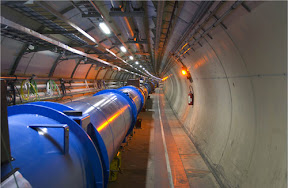
The particular wonder of existence on this day is special cause for celebration, though. Most days we expect to happen. This day, some feared would not. By now, said the voices of panic and dread, we might already be sucked into a black hole of our own creation. The inaugural operation of the Large Hadron Collider, a $6 billion particle accelerator, was to be the makings of cosmic cataclysm, a galactic convulsion, a simultaneous act of creation and destruction that would bring about the end of days and the dawn of time.


Large Hadron Collider

To say that all fears have been allayed is to ignore this message from the future. But to say that the worst has already happened would be to ignore clear signs from the present. We may yet pass through a wormhole to another time, get sucked into some alternate dimension, or be consumed by strangelets. Clearly, we are not out of the woods. That you’re not dead yet is hardly reason to discard the sound thinking of our nation’s best alarmists and conspiracy theorists. Rather, it is reason to grieve that in this sputtering economy, six billion dollars doesn’t accelerate as many particles as it used to.


Be that as it may, today is. Therefore, today is a fine day for a beer. With the apocalypse thankfully delayed, yet ominously looming, it’s a most fitting day for Unibroue’s La Fin Du Monde. A bottle conditioned Belgian-style tripel, La Fin Du Monde – the end of the world, as any first-year French student could tell you – is a potion as complex as the quantum mechanics that we understand only well enough to be sure of utter destruction. Flavors and aromas collide – sweet and spicy, fruity and malty, and the drying bite of 9% alcohol – to create a decadent but blissful experience that is far preferable to the actual end of the world.


Which, by the way, isn’t imminent.

Friday, September 5, 2008

10 Yard Fight


It has gotten rather out of hand, hasn’t it? The epic nature of these daily meditations on beer; paragraph upon paragraph, filled with countless links threatening to send the reader off on a beerless tangent. A quick strike, some instant offense – a change of pace from this relentless grind – is, however desirable, perhaps not destined to be found on these ever-discursive pages.


A quick strike is precisely what was needed and found, though, on this day in 1906 when a struggling ground attack led St. Louis University football coach Eddie Cochems (left) to do the inconceivable. He ordered halfback Bradbury Robinson to throw a forward pass – the first such play to be legally executed in a sport that had long been a battle for possession of the ball more than a battle for yardage. With only five yards needed (in three downs) for a first down, the best defense in those days was a patient and plodding offense. Methodically carving out small chunks of territory made an offense nearly unstoppable. Passing, on the other hand, was nearly unthinkable.


“The history of football has been a story of limiting the power of the offense,” wrote Elmer Berry in the opening lines of his brief 1921 book The Forward Pass In Football.


The defense has never been restricted, never curtailed, never hampered, always free to line up as it chose, to go when it pleased (barring offside), where it pleased and do practically as it pleased. Always the offense has been too strong, too powerful, and there has been the necessity of legal restrictions directed toward equalizing the attack and defense. 


In the “old game,” as Berry described it, “If a team won the toss and took the ball there was practically nothing but a fumble between them and a touchdown.”


All sorts of ingenious formations were devised for massing power on the weak spot. The famous "guards back" of Pennsylvania, the "flying wedge" of Deland of Harvard, the "turtle back" wedge of others, the rolling mass on tackle and others of this type will bring a smile of reminiscence to "old-timers." Men were pushed, dragged and hauled along by their team mates. Often special straps were attached to the uniform to facilitate this work, and even to make possible throwing a man bodily, feet first, over the prostrate lines. 


The very nature of the sport would change, as St. Louis University went on to an undefeated 11-0 season, outscoring opponents 407-11. The forward pass had been utilized on rare occasion in the past, in defiance of existing rules, but even with a new rule legalizing the play – a rule implemented to make the game safer after a 1905 season filled with on-field injuries and even deaths – teams were slow to adapt to, and reluctant to adopt, the forward pass. It was the sheer dominance of an offense led by Robinson, the gridiron’s first triple threat, that began the revolution.


Even in those early stages of revolution, it was a game that would hardly be recognizable to modern enthusiasts of American football. Writes Berry:


At first one forward pass could be made by any player anywhere behind his line of scrimmage to any player on the end of the line or one yard back of it provided the pass crossed the line five yards out from center. It was completed if touched by any eligible player before it touched the ground. Any illegal pass went to the opponents at the spot from which the pass was made. A forward pass over the goal line became a touch back. 


“Naturally,” he explains, “a period of intensive experimentation followed.”


It’s a different game now as we head into the opening weekend of the NFL season. It’s a new era. The Ocho Cinco era. The age of the Post-Favrian Packers. A year in which Daunte Culpepper bitterly ended his career. A time in which Shawne Merriman seems recklessly hellbent on putting the “lights out” on his own career. Pacman Jones has been reinstated and will be playing at Texas Stadium – a stadium from which Jessica Simpson has most certainly been banned. John Madden has already filled the horse trailer with turducken, and ESPN undoubtedly hopes to fill its Monday Night Football broadcast booth with another half dozen commentators to add to the noise.


The warm-blooded of America will spend this Sunday glued to the television, renewing old rivalries, discovering new heroes, damning the half-point prevarications of Vegas oddsmakers to hell – and of course, being endlessly bombarded with mixed messages about how their choice of beer defines their manhood.


Why the insecurity? Beer is not a battleground for male dominance (though the dawn of the triple IPA may suggest otherwise). It is an art, like throwing the perfect spiral. It is, like any team’s playbook, a world of options – at times relying on brute force, at other times finesse or even trickery. Choosing the right beer, like calling the right play, is situational – and ultimately the right one is the one that works. So, on this fine day – this fine football weekend – for a beer, tune out the ads and call your own plays.

Thursday, September 4, 2008

Endless Summer

There’s a randomness to the universe that, to simple minds such as this one, can no better be comprehended through science than philosophy or religion or myth. It’s a vast and mysterious wonder, meant to be explored but not to be understood. For all the inscrutable and arbitrary character of the cosmos, though, there are times when the stars align just right, and a sequence of events unfold that somehow just make sense.


On Monday, Labor Day brought summer to its symbolic close. 


Tuesday arrived, and where others stepped with trepidation into a gloomy, summerless world, Brian Wilson responded with utter defiance. The very icon of summer, the genius of the Beach Boys – indeed, the genius above all others in American pop music – rekindled summer’s torch with That Lucky Old Sun. Wilson’s new CD is widely being recognized as his best solo work in years, and the perfect complement to his revered 2004 completion – or perhaps re-imagination – of the Beach Boys’ never-released Smile


Smile: the here and now of another time thrust oddly into the future. That Lucky Old Sun: a slice of the here and now that’s wistfully nostalgic for a time when innocence was first being lost. Both evidence of a creative spirit renewed, proof that summer can live on even in the autumn of one’s life. To put it far more crudely than is deserved, the only voices Brian Wilson is hearing in his head these days are singing in breathtaking harmony.


Wednesday, September 3, a seemingly unrelated and innocuous relic of history: The date when, 13 years ago, a broken laser pointer went up for auction on a tiny web site. That web site would, in time, grow up to become eBay, a multi-gazillion dollar corporation that provides the world with a sanitary alternative to dumpster diving.


And finally, today, September 4. A fine day when this Fine Day’s own home base of Los Angeles celebrates its birth in 1781. A group of just 44 people – half of them children – from what are now the Mexican states of Sonora and Sinaloa officially broke ground on El Pueblo de la Reina de Los Angeles. Long before it was a concrete-lined drag racing  strip in Grease, the Los Angeles River (if you prefer, El Rio de Nuestra Señora La Reina de Los Angeles de Porciúncula) was, believe it or not, a pristine waterway and the primary source of water for the new settlers.


Though that rare day after a hard rain offers a fleeting, magnificent glimpse, it’s difficult to imagine a time when anything was pristine in the smoggy and filthy expanse of concrete that is modern day Los Angeles. Not even the women are as nature made them. Oh, some of them are – but the disturbing and all-too-frequent visual encounters with grotesque collagen-implanted lips, and middle-aged women whose lunch lady arms are juxtaposed with gravity-defying D-cups, are enough to make one thankful that they can’t all be California girls.


Just the same, Los Angeles is indisputably the dream factory, the place where the myths and lore of Southern California are made. That Lucky Old Sun is an ode that iconic Southern California – whether it’s a lost world, or merely an idyllic figment of the collective imagination.


And here’s where the stars have aligned: eBay – the very same eBay, which just yesterday celebrated a birthday of sorts – is home now to a charitable auction of some items a bit more desirable than a broken laser pointer. To be specific, a That Lucky Old Sun surfboard from surfer and custom surfboard maker Robert August and handwritten, autographed lyrics to Brian Wilson’s “Forever She’ll Be My Surfer Girl.” Every last penny (ah, to be so lucky) of the proceeds benefit our friends at the Surfrider Foundation, so bid away. (The auction closes at 5pm EDT on Friday, September 12.)


Our friends? Really? Well, ok. It just sounded good. But if we were the ocean, they would be our friends. Just ask the man himself: "The Surfrider Foundation has always done an outstanding job in preserving our precious oceans, waves and beaches," says Brian Wilson. "I want to do all I can to help." 


Yes, indeed. The word of God – or a god, anyhow – on this fine day for a beer. And to tie it all together as you blow your life’s savings, there could hardly be a more appropriate indulgence than Karl Strauss’s Endless Summer Light. It’s appropriate for obvious reasons: it is in fact named for the Endless Summer surf films, the first of which prominently featured Robert August. Endless Summer is also, of course, the title of one of the greatest collections of greatest hits ever assembled.


It’s not merely the obvious, though, that recommends this SoCal brew today. Endless Summer may be Light, but it is decidedly not “Lite.” No, nary a hint of the juice of a goat’s bladder in this fine drink. Instead, a refreshingly crisp finish and light mouthfeel conspire with a delicate Saaz hop aroma to bely the surprisingly full malt flavor of Endless Summer Light. Where others may leave you looking anxiously ahead to the bolder flavors of colder seasons, this is that rare warm weather beer that will leave you pining for an endless summer. A fine choice for sure on a fine day for a beer.


Tuesday, September 2, 2008

London's Burning

One of the hurdles in running a web site, as it turns out, is that the internet exists somewhere in the outside world. Our connection to it is tenuous and fragile. As any who gain access to this universe of information through their local cable company have undoubtedly experienced firsthand, those blinking modem lights are frequent bearers of bad news. “Always connected” only means always sometimes. So it can be said that last Friday was a fine day for a beer – but it couldn’t be said on these pages. As the shortened work week begins, today, too, is a fine day for a beer. Only at this late hour, however, can we offer such words of encouragement, thanks to another (albeit briefer) lapse in service.


All in all, though, such inconveniences are only that. So we were reminded over the weekend, although to date Hurricane Gustav’s effects appear to have been thankfully less severe than initially anticipated. So, too, were the residents of London reminded on this day in 1666, long before the convenience of the internet had ever been imagined.


It was in the early morning hours of September 2, 1666, when fire broke out at the Pudding Lane home of the king’s baker, Thomas Farrinor. If the narrow streets tightly packed with timber framed houses, the preponderance of thatched roofs, the nearly year-long drought, or the evening’s steadily blowing wind gave ample cause for alarm, at least one key figure was underwhelmed by the possibility of disaster. Lord Mayor of London, Sir Thomas Bloodsworth was said to have suggested that “a woman might piss it out” upon being awoken with news of the fire. 


Such bold leadership in a time of crisis undoubtedly fanned the flames as effectively as any flying sparks or gusts of wind. The Great Fire of London, which might easily have been contained had Bloodsworth more readily heeded the advice of his firefighters and authorized the demolition of nearby houses, instead raged on until September 6. It was “an infinite great fire,” observed diarist Samuel Pepys on only the fire’s first day.


Says Neal Hanson, author of The Great Fire of London: In That Apocalyptic Year, 1666 and, more recently, The Dreadful Judgment: The True Story of the Great Fire of London, “The rising sun that fifth morning, when the fire had been put out, was casting light on ground that had been shaded since before the Norman Conquest. Medieval London had virtually ceased to exist and in its place was a wasteland of rubble and ashes, so devoid of buildings, so empty and featureless, that to one stupefied onlooker it seemed like the Cumbrian fells. ‘But there’s nothing to be seen’ he said, ‘but heaps of stones.’”  


The fire, according to the Museum of London’s account, destroyed some 436 acres (a mere 373 acres, says the BBC), encompassing more than 13,000 houses. The rather dubious official death toll from the fire is listed at just six; the numbers left homeless, by some estimates, were in excess of 100,000. Rebuilding started almost immediately – many houses were rebuilt within the first five years – but it was nearly 45 years before the completion of the new St. Paul’s Cathedral brought the rebuilding process to a close.


Conspiracy theories swirled in the wake of the fire, with much of the blame resting on London’s Catholic population. So prevalent was the perception of a Catholic hand in the fire that for years the monument at Pudding Lane included an inscription blaming the “barbarous Papists.” In the fire’s immediate aftermath, meanwhile, Samuel Pepys wrote, “It was pretty to see how hard the women did work in the cannells, sweeping of water; but then they would scold for drink, and be as drunk as devils. I saw good butts of sugar broke open in the street, and people go and take handsfull out, and put into beer, and drink it.”


As fine a day at it may be for a beer, we can hardly advise in favor of such crude practices. Instead, as we recall those who suffered and those who died at the hands of this vast inferno, today would be an ideal day to enjoy a Fuller’s London Porter. While Fuller’s as we know it did not come into existence until nearly two centuries after the Great Fire, the origins of their famed Griffin Brewery in Chiswick are rather more hazy. While company lore dates the location’s brewing history back to the time of Oliver Cromwell – a reign ending nearly a decade before the fire – British National Archives point to 1699 as the brewery’s infancy (while yet others suggest 1701).


The precise provenance of the brewery may be debatable; what can hardly be disputed is the magnificence of the London Porter, a coffee colored concoction with a tantalizing tan head, rich roasted malt flavor, and a subtle, sultry smokiness in its finish. Alliteration abuse alone does it little justice, though, so pour yourself a pint and savor its every drop.


Savor it, perhaps, while playing the Great Fire of London game. A difficult challenge? Hardly. You’ll find challenge enough, though, in trying to resist pouring “just one more pint” of Fuller’s London Porter on this fine day for a beer.